
If you were hurt in a car accident in South Africa, you’ve probably heard of the letters RAF a lot by now. Your lawyer says it. Your doctor says it. Even your neighbour in Sandton has an opinion, whether you asked or not. But what does RAF actually mean for you? Why does almost every serious claim need an industrial psychologist at some point? Let’s break it down. This is your claim. You deserve to understand it.
We’re The IOP, based in Sandton, Johannesburg. We’ve done this work for over 40 years now. It written more than 1,000 medico-legal reports for both plaintiff and defendant attorneys across the country. We’ve seen what makes a claim hold up. We’ve also seen what makes one fall apart the second the RAF’s lawyers start asking questions.
What Is the Road Accident Fund (RAF)?
The Road Accident Fund, or RAF, is a government body. It pays compensation to people injured in car accidents on South African roads. The idea is simple. Victims of someone else’s bad driving shouldn’t have to carry the full cost alone. If a driver’s negligence caused your accident, even partly, you may have grounds to claim.
You can claim for medical costs. You can claim for pain and suffering. It can also claim for lost income. That last part gets messy fast. This is where an industrial psychologist earns their keep.
RAF Claims doesn’t pay out based on a guess. Claims need proof. Real proof that holds up in court. Doctors confirm the injury. Occupational therapists check how it affects daily life. But there’s a harder question. Can this person still earn a living the way they used to? That question belongs to an industrial psychologist.
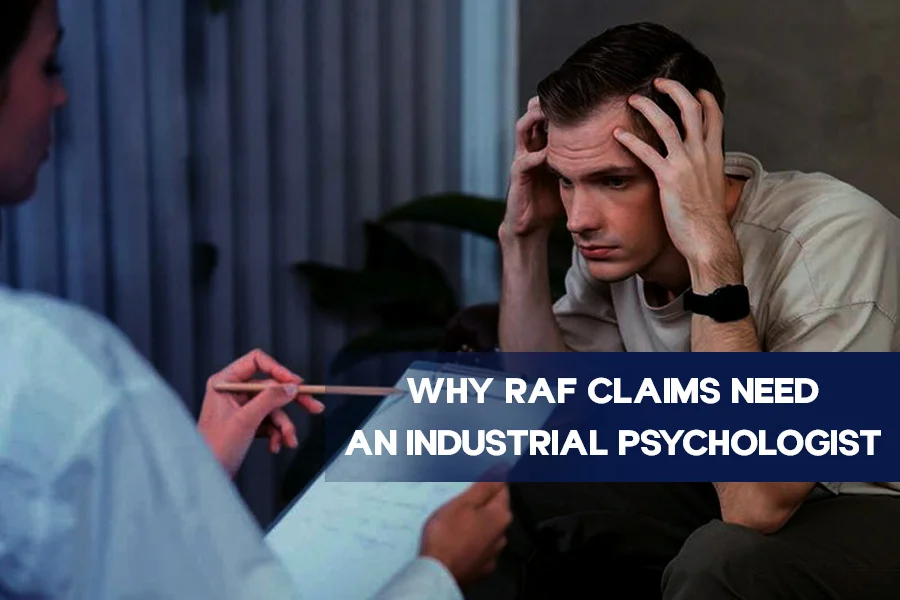
Why RAF Claims Need an Industrial Psychologist
Here’s something most people don’t realise until they’re deep into a claim. A broken leg heals. A bad disc can often be treated. But some damage follows a person for the rest of their working life. It doesn’t always show up on an X-ray. It shows up in what a person can no longer do at work.
That’s what an industrial psychologist examines. How does the injury change what this person can do on the job? Can they go back to their old role? What will their earnings look like now, compared to before the accident? This isn’t a guess. It’s built on psychological testing, a detailed work history, and real labour market data from the area where the person lives.
Vocational Assessments
The vocational assessment sits at the center of this process. The psychologist looks at the claimant’s schooling, work history, and physical and mental ability. They also look at the job market where the person lives, whether that’s Johannesburg, Durban, or a small town in the Eastern Cape. From there, they decide if the person can return to their old job, shift into something lighter, or can’t work at all anymore.
Take a bricklayer who worked on building sites for fifteen years. Say the accident leaves him with permanent shoulder damage. He might still be able to work, just not in construction. The vocational assessment captures that shift. It puts an actual rand figure on what it costs him over the rest of his working life.
Loss of Earnings Calculations
This is where the report carries real financial weight. The industrial psychologist works with an actuary. Together they calculate two things. First, past loss of earnings. That’s income lost between the accident and the date of the report. Second, future loss of earnings. That’s the gap between what the person would have earned and what they can earn now.
These numbers account for career growth the claimant likely would have had. They factor in retirement age and inflation too. They even weigh the chance of a promotion that never happened because of the injury. It’s detailed work. And it’s the kind of detail that can mean the difference between a fair settlement and one that leaves a family struggling for years.
Pre- and Post-Accident Comparisons
A good industrial psychologist paints a clear picture of your life before the accident. Then they line it up against your life after. Job title, salary path, physical demands of the role, even softer things like job satisfaction or job security, all of it gets weighed. Courts want this comparison spelled out clearly. Not hinted at. Not assumed. Written down, with evidence behind it.
How Industrial Psychologists Work With Other Experts
RAF claims rarely rest on one expert’s word alone. A typical case might involve an orthopedic surgeon, a neurosurgeon, an occupational therapist, a clinical psychologist, and an actuary. All of them feed into the same file. The industrial psychologist combines all of it, since their findings depend on what the medical experts establish first.
Here’s a simple example. Say an orthopedic surgeon confirms a claimant has a permanent 20% loss of function in one arm. That’s a medical fact. The industrial psychologist’s job is to turn that fact into something a court can use. What does that 20% loss mean for this person’s specific job? What does it mean for their income over the rest of their working life? Skip that step, and the medical finding is just a number on a page.
Actuaries then take those conclusions and build the financial model. They apply discount rates, life expectancy tables, and inflation assumptions. Then they land on a final rand figure. If the industrial psychologist’s report is vague, that number on top of it gets shaky too. This is why so much of a claim’s strength traces back to this one report.
A Real Example of How a Report Changes an Outcome
Picture two claimants with almost identical injuries. Both are truck drivers. Both hurt their lower backs in accidents on the N3 near Pietermaritzburg. The first claimant’s psychologist turns in a short report. It just says the client “cannot return to truck driving.” There’s barely any explanation behind it.
The second claimant’s report reads very differently. It walks through the physical demands of long-haul driving. It cross-references the treating doctor’s findings on function. These looks at the claimant’s limited schooling and the fact that he lives in a rural part of KwaZulu-Natal, where other jobs are scarce. The concludes, with clear reasons, that any replacement work would pay much less.
That second report gives the court something solid to work with. It answers the hard questions before anyone has to ask them. Across more than 1,000 reports we’ve handled, this kind of detail usually makes the difference between a strong award and one that gets picked apart in court.
What Happens During an Industrial Psychology Assessment for RAF?
Most people walk into their first assessment with no idea what to expect. Fair enough. Let’s walk through it.
It usually starts with a detailed interview. The psychologist asks about your schooling, your work history, your job duties, and how the accident changed your daily life at work. Psychometric tests come next. These measure things like competency, skills, aptitude, and sometimes personality traits that matter on the job.
Collateral information matters too. A call with a former employer and checking old payslips or bank statements. It might mean comparing notes with other medical reports already on your file. None of it sits alone. The final report pulls it all into one clear story. A judge with no psychology background can follow it and trust it.
Assessments usually run a few hours. Sometimes they involve a follow up assessment if the case is complex. This isn’t something to rush. A good psychologist won’t rush you either.
How Long Does an RAF Industrial Psychology Report Take?
Timelines shift depending on the case. Most claimants should expect four to eight weeks from the first assessment to the final report to allow for other experts to submit their reports and collateral documentation to be collected. Complex cases with several specialists or contested liability can take longer. At The IOP, we keep turnaround times reasonable and competitive. But we never cut corners on accuracy.
What Makes a Strong RAF Medico-Legal Report?
Not every report carries the same weight in court. A strong report is thorough without being padded. It’s specific without losing the bigger picture.
A few things separate a solid report from a weak one. Current HPCSA registration is a non-negotiable. Without it, a report isn’t even admissible. The methodology needs to be clear. A reader should be able to follow how the psychologist got from evidence to conclusion, not just be handed a final number. The report should also get ahead of arguments the other side is likely to raise. Ignoring them just invites a harder fight later.
Reports that read like a checklist tend to fall apart under cross-examination. Reports that tell a clear, evidence-backed story of how someone’s working life changed tend to hold up much better.
Common Mistakes That Weaken RAF Claims
A few patterns show up again and again in weaker claims. Most are avoidable with the right guidance early on.
Waiting too long to book the assessment is a big one. Leave it until close to trial, and there’s little time left to gather collateral information or fix gaps the RAF’s own experts might use. Inconsistency is another. Telling your doctor one thing, your attorney another, and your industrial psychologist something slightly different, that gets magnified in court, even when it’s innocent.
Overstating limitations is a trap too. If surveillance footage or an old social media post contradicts what a claimant says they can’t do, credibility takes a hit fast. Then there’s picking an assessor based on price or speed alone, instead of real RAF litigation experience. This is specialised work. Psychologists without that background often miss details that matter most. That gap tends to show up at the worst possible moment.
Choosing the Right Industrial Psychologist for Your RAF Claim
Experience with RAF or personal injury litigation should be top of your list. Ask how many RAF or medico legal reports the psychologist has completed. Ask if they’ve given expert testimony in the High Court before. Staying calm under cross-examination is its own skill. It’s separate from clinical ability, and it matters just as much for your outcome.
Our team at The IOP has testified in High Court matters throughout South Africa. Attorneys have come to see us as one of the leading names in this field. That kind of track record isn’t something every practice can claim.
Confirm HPCSA registration yourself. Don’t just take someone’s word for it. Look for a psychologist who explains things in plain language. You’ll likely lean on them to answer questions from counsel. Don’t hesitate to ask for a sample report structure, with names removed, so you know what you’re getting before the assessment even starts.
The Cost of Skipping This Step
Some claimants want to settle fast and move on. They ask if they can skip the industrial psychology assessment and rely on medical reports alone. In very minor cases, that’s technically possible. In most cases, it’s a costly mistake.
Without a proper vocational and earnings assessment, the loss of income part of a claim usually gets badly underestimated. Sometimes it’s left out entirely. Attorneys who handle RAF matters regularly will tell you the same thing. Settlements missing a solid industrial psychology report almost always land lower than they should. Sometimes by hundreds of thousands of rand, simply because there’s no expert evidence backing up the long-term financial damage.

How Attorneys and Industrial Psychologists Work Together
Good outcomes usually come from good teamwork between your legal team and the industrial psychologist. Your attorney should brief the psychologist early. That means case details, medical history, and any legal arguments that will shape the report. The industrial psychologist should flag anything unexpected that comes up during the assessment.
This isn’t about steering the psychologist toward one conclusion. Their opinion has to stay independent, since it needs to hold up under oath. It’s about making sure nothing slips through the cracks between the legal and psychological sides of the case.
Frequently Asked Questions
What does RAF stand for?
RAF stands for the Road Accident Fund. It’s a South African government body that compensates people injured in motor vehicle accidents caused by another driver’s negligence. It was set up under the Road Accident Fund Act 56 of 1996.
Do I need an industrial psychologist for every RAF claim?
Not always. Minor injuries with no lasting effect on employment usually don’t need this level of assessment. But if the injury potentially affects your ability to work, now or later, this kind of report becomes essential for proving loss of earnings.
How much does an industrial psychology assessment cost for an RAF claim?
Costs vary by practice and case complexity. Many attorneys arrange for these costs to be covered upfront, or recovered once the claim succeeds. It’s worth discussing payment with your attorney before you book anything.
Can the RAF dispute my industrial psychologist’s findings?
Yes, and it happens often. The RAF usually brings in its own industrial psychologist. Disagreements between the two experts are common. This is normal, and it’s part of why report quality matters so much. A well-supported report is much harder to challenge.
How soon after my accident should I get an industrial psychology assessment?
Wait until your treating doctors say your condition has stabilised enough to judge the long-term impact. That’s often somewhere between several months and a year after the accident. Your attorney will guide the exact timing.
Does The IOP handle claims outside of RAF matters?
Yes. Beyond RAF work, The IOP also handles PRASA and Metro Rail claims, insurance claims, medical negligence claims, wrongful arrest, public liability claims, and maintenance assessments tied to divorce proceedings.
Get Expert Help With Your RAF Claim
A RAF claim is rarely just about medical bills. It’s about rebuilding a financial future that got taken away, sometimes for good. Industrial psychologists turn the human cost of an injury into evidence a court can actually use. That work often decides whether a settlement reflects what someone truly lost.
The IOP brings over 40 years of combined experience to every case. We’ve completed more than 1,000 medico legal reports, with a track record of High Court testimony across South Africa. If you’re working through an RAF claim right now, talk to your attorney about bringing us in early. Reach us at raul@theiop.co.za or call +27 (72) 160 5108. We’re based at 155 West Street, Sandton, and we work with attorneys and claimants across the country.
This article is for general information only. It doesn’t count as legal or psychological advice. Speak to a qualified attorney and an HPCSA-registered industrial psychologist about your specific case.